A Coastal Proposal Reading Session for a Small Group
A coastal proposal reading session helps a small group track a public document’s aim, mark uncertainties and leave with clear questions for follow-up.
The common mistake in a coastal proposal reading session is trying to settle the shoreline dispute before anyone has agreed on what the proposal actually says. That can turn a quiet reading into a contest of confident interpretations, leaving the group with more heat than clarity. A better aim is modest: read one public document together, record its stated purpose, and collect questions that still need answers.
This format suits a neighborhood association, a library discussion group, or a few residents who want to understand a draft beach-access plan, dune-restoration proposal, or harbor-management policy. It is not a public hearing, a vote, or a substitute for technical review. Think of it as a shared first pass that helps people distinguish the words on the page from the assumptions they bring to them.
What should the group prepare before it meets?
Choose one document, not an entire folder. A proposal may arrive with maps, appendices, meeting notices, environmental material, and agency correspondence. For this session, select the main proposal or the particular section the group wants to understand. Keep related materials nearby as references, but do not let them quietly become a second reading assignment.
Send the document to participants ahead of time, along with a short note explaining the purpose: identify the stated aim and gather unanswered questions. Ask people to bring a printed copy or a device they can comfortably annotate. If the document is a scan, check that the text is readable and that maps or tables are not missing from the file.
One facilitator is enough for a small group. Their job is to keep the discussion tied to the document, make room for different readings, and capture questions accurately. A second person can take notes if available, but a formal chair, slide deck, or expert panel is unnecessary. A quiet room, pens, sticky notes, and a visible sheet of paper for the question list will do.
Before the meeting, prepare three simple labels for notes: stated for something the proposal explicitly says, inferred for a reasonable reading that is not stated outright, and unanswered for information the document does not provide. These labels are not a scoring system. They make it easier to notice when a conversation has moved from the text into interpretation.
How can a group use one week without making this a project?
A week gives participants time to read without turning preparation into homework. The routine below is flexible: shorten it if everyone can meet sooner, or let the reading period stretch if the document is dense. The aim is a focused conversation, not a complete review of coastal policy.
- At the start of the week: The organizer chooses the document, checks that everyone can open it, and sends the purpose and meeting time. Ask participants to read only the main proposal once, marking passages they want to discuss rather than researching every unfamiliar term.
- Midweek: Each person writes a private note answering two questions: “What does the proposal say it aims to do?” and “What remains unclear?” This makes room for individual reading before the most vocal person sets the group’s interpretation.
- The day before the meeting: The facilitator gathers no more than a few points from each participant, if people are willing to share them. Put overlapping questions together, but preserve differences in wording when they point to distinct uncertainties.
- At the meeting: Follow the session below. Keep the proposal open, record page or section references where possible, and leave disagreements visible rather than forcing a shared verdict.
- The next day: Send participants the notes for a quick accuracy check. Separate questions that the document answers from those that would need an agency response, another public record, or specialist explanation.
There is no need to ask everyone to read background reports, map every affected shoreline, or prepare a speech. Those tasks may suit a later review, but they can crowd out the simpler question here: what aim does this proposal state, and what does the group still need to know?
What happens during the reading session?
Start by naming the limits of the meeting. The group is not deciding whether the proposal is good, recommending a design, or speaking for all residents. It is reading one document and making a useful record of what is clear and what is not. That boundary can lower the pressure on participants who are new to public policy documents.
Give the group a few quiet minutes to reread the title, opening summary, and any section that states the proposal’s purpose. Ask each person to point to the words that express the aim. If someone says, “It is meant to protect the road,” ask whether the proposal says that directly, suggests it through context, or leaves the intended benefit unstated. The point is not to correct people sharply; it is to keep the record honest about where an interpretation came from.
Next, write a short draft of the stated aim in plain language. Keep it close to the proposal’s wording and avoid adding a judgment. If the document describes several aims, list them separately rather than blending them into a single polished sentence. Participants can disagree about emphasis while still seeing which phrases prompted the disagreement.
Then read the relevant sections in order, pausing to note what the proposal describes and what it leaves open. A coastal document might name a location but not explain how access would be handled during work, or describe habitat goals without clarifying how competing uses were considered. Those are examples of possible questions, not assumptions about any particular proposal. Record the section that raised the question, so a later reader can find the passage quickly.
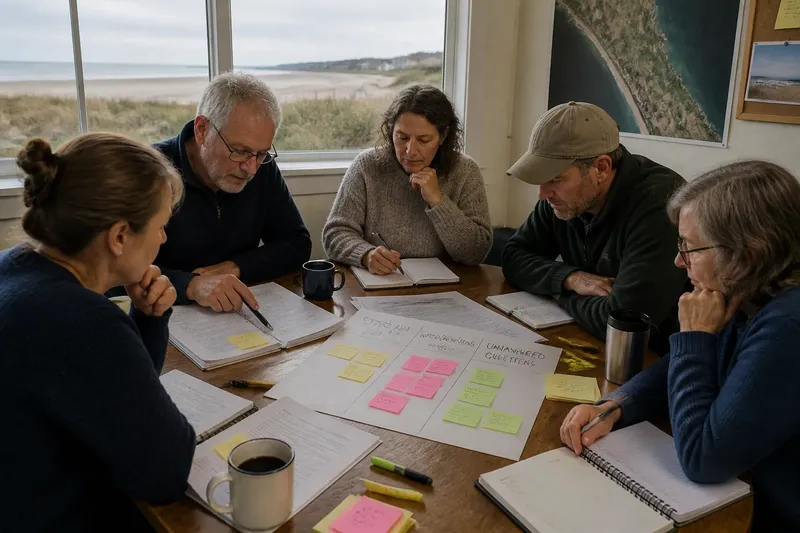
For the final part, sort the notes into three columns: stated aim, interpretations, and unanswered questions. Invite participants to identify any place where a question has been mistaken for a fact, or an inference has been copied into the stated-aim column. End by reading the question list aloud. Do not rank questions by political importance unless the group has a separate reason to do so; this session is about collecting them, not deciding the issue.
How should the group handle disagreement?
Disagreement is useful when it reveals that a sentence can be read in more than one way. It becomes less useful when participants start arguing from memory about what an agency “usually means” or what a shoreline “obviously needs.” Bring the conversation back to the document: which words support that reading, and what would the group need to ask to clarify the rest?
Imagine a group reading a draft access plan that says a route will be “improved.” One participant reads that as a promise of easier public access; another thinks the word could mean a change in the route or its management. The facilitator records both readings under interpretations and adds, “What changes are included in ‘improved,’ and who determines them?” The observable result is a question the group can carry forward, not a forced agreement about what the phrase means.
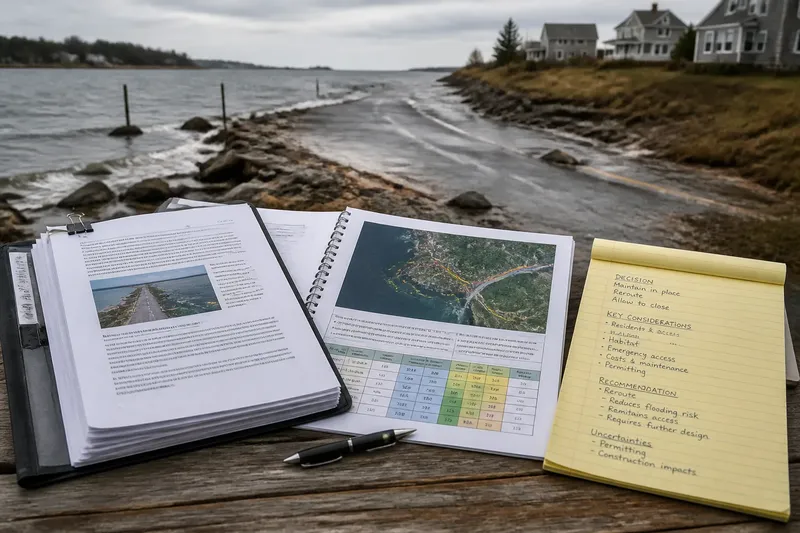
If a participant has direct knowledge of the coast, welcome it as context, then label it clearly as context rather than language from the proposal. A resident may know that a path floods, for example, while the document may say nothing about flooding. Keeping those two records distinct helps the group respect lived knowledge without attributing claims to the document that it does not make.
It is not worth the effort to decode every technical term during this first session. Mark unfamiliar language and ask whether understanding it is necessary to interpret the stated aim. If it is, add a question about the term or identify a suitable source for later. If it is not, let it wait. A glossary hunt can swallow the hour while leaving the proposal’s central purpose untouched.
What questions help readers stay close to the text?
Where does the proposal state its aim?
Look for a purpose statement, summary, or section describing the problem the proposal addresses. Note the page or heading, and distinguish the document’s stated purpose from a benefit a reader expects it to produce.
Who or what does the proposal name?
Notice which places, shoreline features, public uses, communities, or agencies appear explicitly. If a group or resource seems relevant but is not mentioned, record that as a question rather than assuming it was considered or ignored.
What words leave room for more than one reading?
Terms such as “access,” “restoration,” or “improvement” may carry different meanings for different readers. Copy the wording and ask what detail would make its intended meaning clearer.
What would require information beyond this document?
Questions about design choices, environmental effects, implementation, or local procedures may need another record or a qualified explanation. Keep them on the list, noting what kind of source could answer them rather than guessing from the proposal alone.
What should the group do with its notes?
Make the notes short enough that someone who missed the meeting can use them. Include the proposal’s title, the date of the discussion, the plain-language statement of its aim, and the three-column record. Identify questions that were answered by the text, but retain a reference to the passage that answered them. For open questions, include a page or section reference when possible.
Share the draft notes with participants before circulating them more widely. This is a check for accuracy, not a second debate about the proposal. Ask whether the record distinguishes quotations or close paraphrases from interpretation, and whether it captures disagreements without assigning a consensus the group did not reach.
If the group decides to seek clarification, choose a next step that matches the question. A missing explanation in a public document may be suitable for a written inquiry to the responsible office. A technical question about habitat or coastal processes may call for a qualified professional. A question about how to participate in a formal decision should be checked against the relevant public notice and local procedures; those requirements vary by place.
A coastal proposal reading session earns its keep when it leaves people with a clearer account of the document’s stated aim and a question list that is specific enough to use. The group does not need a unanimous interpretation or a verdict. Sometimes the most useful contribution is a carefully framed question, attached to the exact words that prompted it.