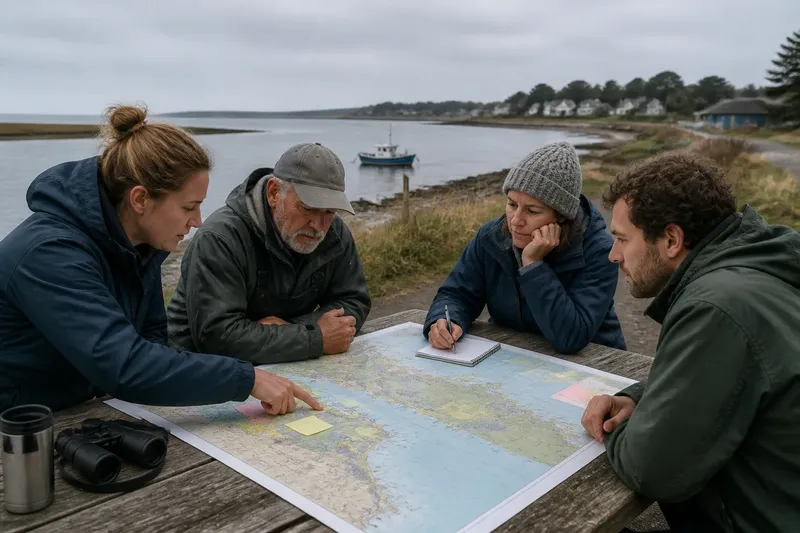
Before the Briefing Note: How Public Policy Papers Took Shape
See how public policy papers turn a coastal problem into options and a recommendation, and learn what their structure reveals about public decisions.
The most common mistake with a public policy paper is to treat it as a neutral container for facts. That can make a reader miss the paper’s real work: deciding which problem deserves attention, which choices count as viable, and what officials are being asked to do. On a shoreline, those choices can shape the future of a harbor, a wetland, or a neighborhood exposed to erosion.
Public policy papers took shape as tools for organizing those decisions. Their form has changed—from longer explanatory documents toward shorter briefing notes and digital summaries—but their central task remains recognizable: connect a stated problem to options and a recommended course, while making the reasoning visible enough to question.
Why did public policy papers take shape?
Public authorities face problems that rarely arrive with a ready-made answer. A coastal community may ask how to protect a road that floods during storms. The issue touches public access, habitat, maintenance, private property, and the use of public funds. A policy paper gives decision-makers a place to see the issue assembled rather than as a series of disconnected demands.
Earlier forms of administrative writing often served as records, explanations, or formal proposals. As government responsibilities and decision processes grew more involved, officials needed documents that could help a reader move from a description of conditions to a choice. The policy paper answered that need by linking evidence, alternatives, and advice in one account.
That link matters. A report might describe shoreline change in detail without asking what should happen next. A policy paper usually makes the decision point explicit: for example, whether to maintain a public asset in place, change its use, or consider another approach. The document does not make the decision on its own, but it frames the decision that follows.
What does the paper’s structure do?
A familiar policy paper often opens with the issue and the decision required, then explains the context, sets out options, compares their implications, and recommends a course. The order is an argument in miniature. Context tells readers what matters; options establish what choices are being considered; comparison supplies the reasons for preferring one.
Each section also sets a boundary. A short problem statement may focus attention on repeated road closures, while leaving wider questions about housing or habitat for another process. That focus can help officials act, but readers should notice what the document does not take up. A paper cannot compare choices that were never included in its options.
The recommendation is therefore not simply the final paragraph. It depends on decisions made earlier about scope, evidence, feasibility, and who is affected. A strong paper makes those connections legible. It explains why an option is considered workable, what trade-offs accompany it, and which uncertainties remain.
How have policy papers changed form?
Many policy papers once arrived as substantial reports, with background material and technical discussion gathered into a single document. Shorter briefing notes later became useful when senior readers needed the decision, its rationale, and the main implications at a glance. Digital formats have added linked appendices, maps, tables, and public-facing summaries.
Shorter does not automatically mean clearer. A compact note may send readers to an appendix for the assumptions behind a cost comparison or a map that shows which places are affected. Digital links can make supporting material easier to reach, but they can also separate the recommendation from the evidence needed to assess it.
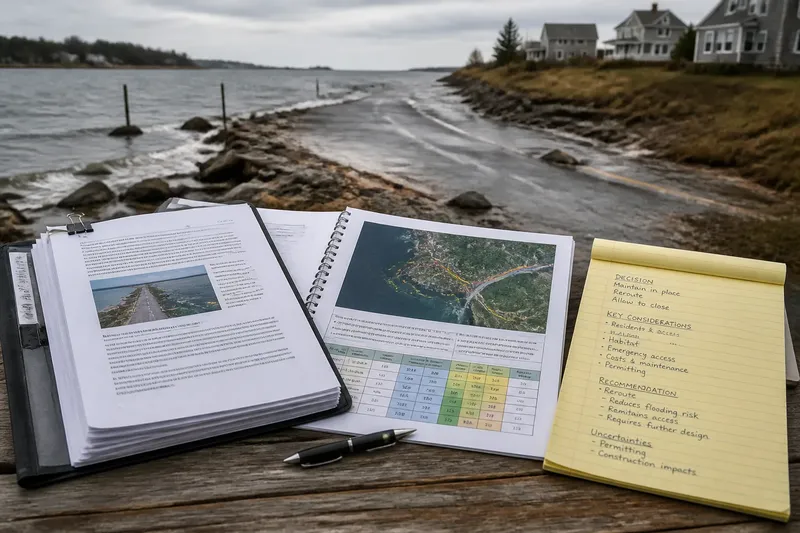
Imagine a county considering whether to keep a low-lying access road open by maintaining it, reroute it, or allow it to close. Its policy paper names the decision, compares effects on residents, habitat, and emergency access, then recommends rerouting while flagging unresolved design questions. A concise briefing note could carry the recommendation, but readers would still need the map and option analysis to understand who gains access and what changes on the ground.
How can you read the reasoning behind a recommendation?
Read the paper as a chain of choices, not just a summary of facts. Ask whether the stated problem matches the decision requested, whether the options represent meaningfully different courses, and whether the comparison uses criteria that the affected community could recognize as relevant.
- Find the decision: Identify what officials are being asked to approve, defer, or direct for further work.
- Check the problem statement: Notice which impacts and places it includes, and which it leaves outside the paper’s scope.
- Compare the options: Look for distinct alternatives rather than several versions of the recommended course.
- Follow the evidence: See whether claims in the recommendation point to analysis, maps, or appendices.
- Look for trade-offs: Note who bears disruption, what public benefits are expected, and where uncertainty remains.
- Separate advice from approval: Confirm whether the document recommends action or records a decision already made.
One aspect is not worth the effort: trying to infer the whole decision from a polished executive summary. It is designed to compress. A quick comparison with the options table and the wording of the requested decision often reveals more than repeatedly rereading the opening pages.
What do readers often ask about policy papers?
Is a policy paper the same as a briefing note?
A briefing note is often a short form used to present an issue and advice to a decision-maker. A policy paper may carry more context and analysis, though naming practices differ across public bodies.
Does a recommendation mean the decision is settled?
No. A recommendation is advice offered to the person or body with authority to decide. The paper may inform a later approval, revision, referral, or request for more analysis.
Where do technical details usually appear?
They may sit in the main text, appendices, maps, or linked documents. Check references beside important claims so you can find the underlying material rather than relying only on a condensed summary.
Can a policy paper show who was affected?
It can describe affected groups, consultation, or anticipated impacts, but the level of detail varies. Look for whose experience informs the analysis and whether unresolved concerns are recorded.
Why does the paper’s form still matter?
A public policy paper is both a decision aid and a record of how officials organized a choice. Its changing form can make advice easier to scan, but the reader’s essential task stays steady: trace the path from problem to options to recommendation. For coastal planning, that habit helps distinguish a carefully explained proposal from a conclusion whose supporting choices remain out of view.
The next time a shoreline briefing note lands in front of you, begin with the decision it asks for, then follow its reasoning backward. If the options, trade-offs, or affected places are hard to locate, that is useful information too: it points to the questions a public discussion still needs to ask.